Everything from pairs: the quantum Ising chain in the Dirac basis
Appendix C of our paper: in the Dirac basis, every amplitude of the Ising ground state is a Pfaffian of one pair matrix, which obeys a single matrix Riccati equation.
Dieser Artikel ist auf Englisch verfügbar.
The quantum Ising chain in a transverse field is one of the classic exactly solvable models of physics. Its solution is textbook material. Appendix C of our paper does not provide a new solution; it shows how the known solution emerges directly from the Schrödinger equation written in the Dirac basis, with no Jordan–Wigner transformation. Every claim below was checked numerically on chains of 6 and 8 spins.
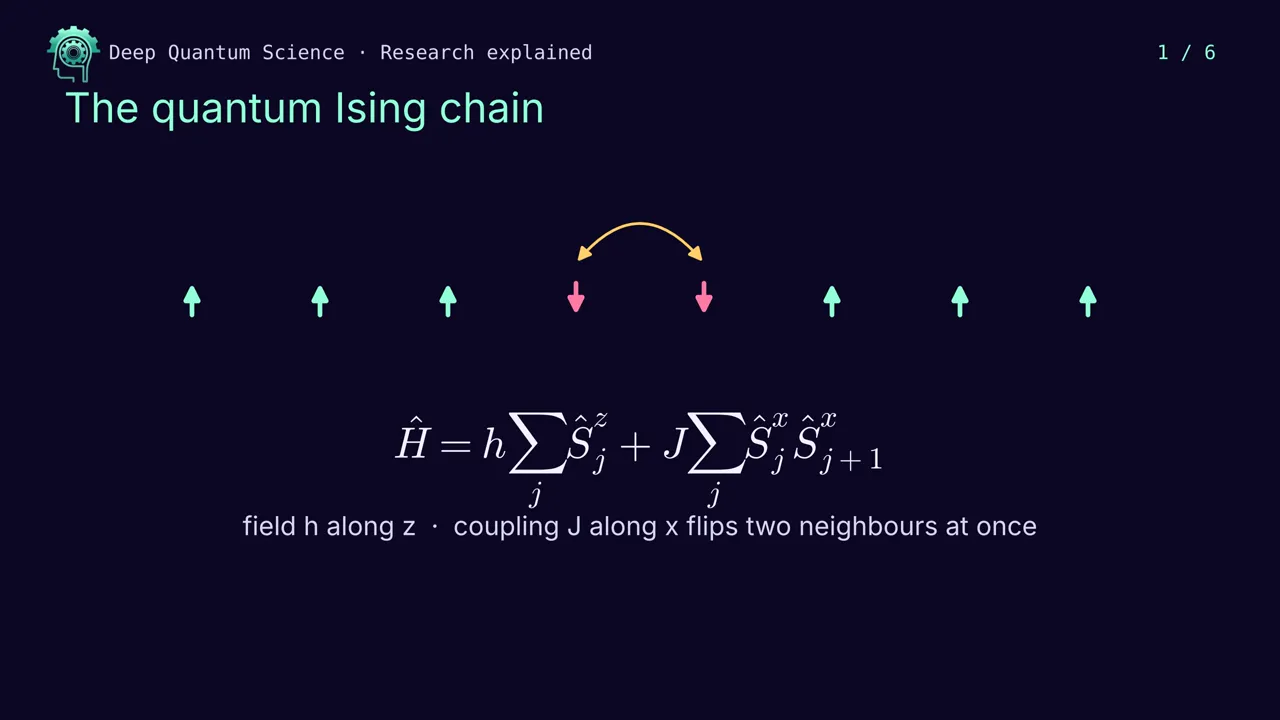
The model
A field h along z aligns the spins; the coupling J along x flips two neighbouring spins at once. Unlike the XXZ chain studied in the main text of our paper, the magnetisation is therefore not conserved.
Even and odd sectors
In the Dirac basis a configuration is a binary number n, with qj = 2K−j. A pair flip is a jump n → n ± qj ± qj+1, which changes the number of down spins by 0 or 2. Its parity is conserved, and the ground state lives in the even sector:
The pair matrix
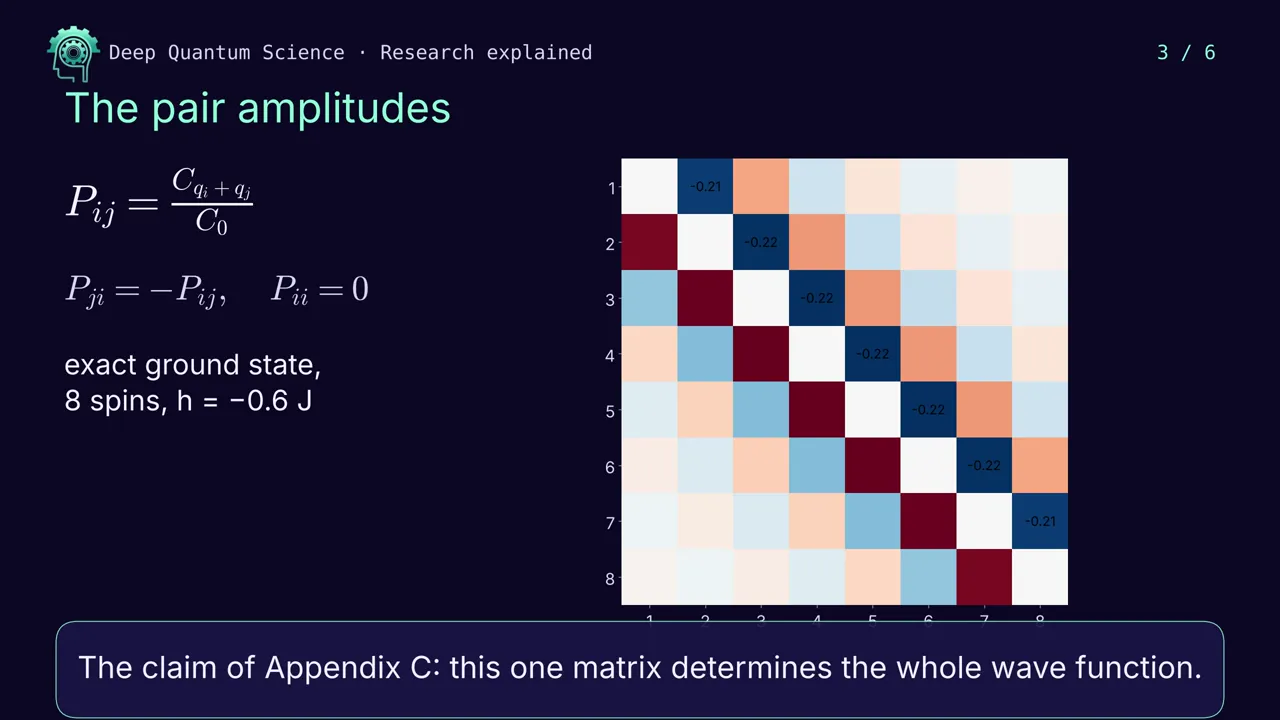
Divide each two-spin amplitude by the amplitude of the all-up state: Pij = Cqi+qj/C0. Exchanging the two spins changes the sign, so P is an antisymmetric matrix.
Four spins are a Pfaffian
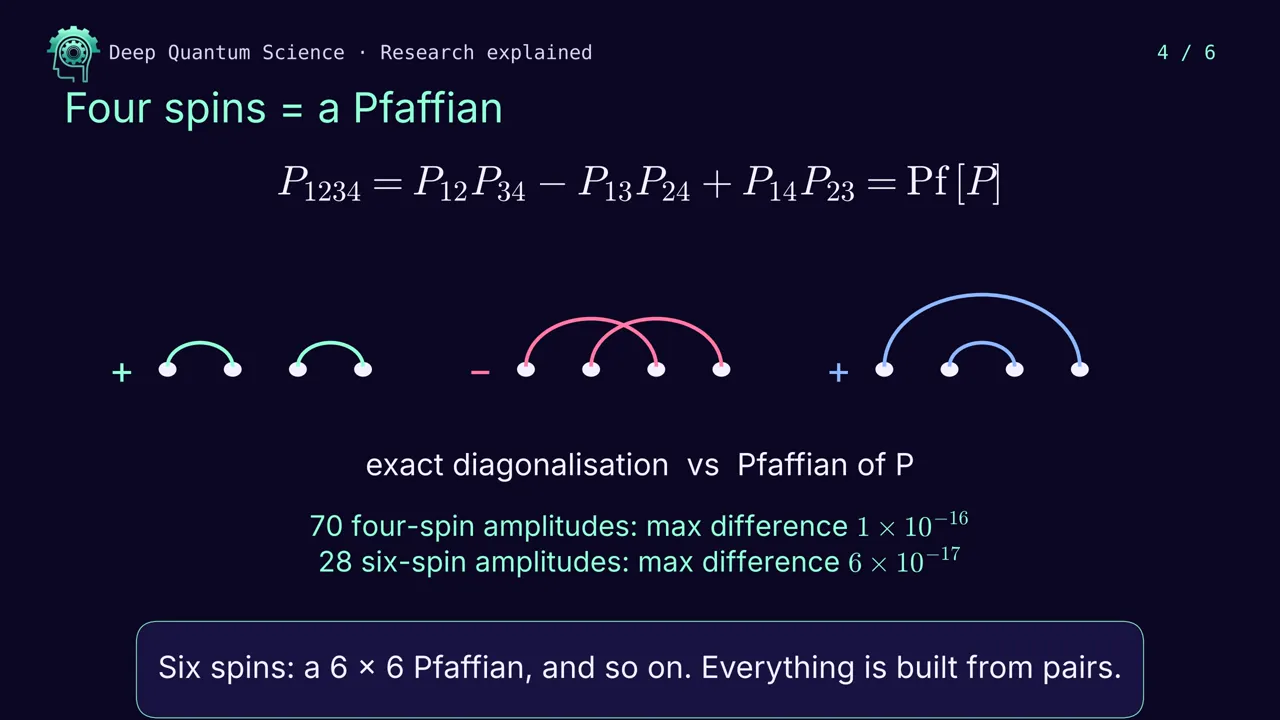
Four down spins can be grouped into two pairs in exactly three ways. Adding the three pairings with alternating signs gives the Pfaffian of P:
We compared this with the exact ground state of 8 spins: all 70 four-spin amplitudes agree with their Pfaffians to 10−16, and all 28 six-spin amplitudes to 6×10⁻¹⁷. The whole wave function is built from pairs, the same structure as in the theory of superconducting pairing.
One matrix equation
Inserting the Pfaffian form into the Schrödinger equation, the four-spin terms cancel. What remains is a single equation for the K×K matrix P, an algebraic matrix Riccati equation:
where T and A are the symmetric and antisymmetric nearest-neighbour matrices. The exact pair matrix satisfies it to 10−15. No ansatz has been added: the equation follows from the Dirac-basis Schrödinger equation alone.
Linearise and solve
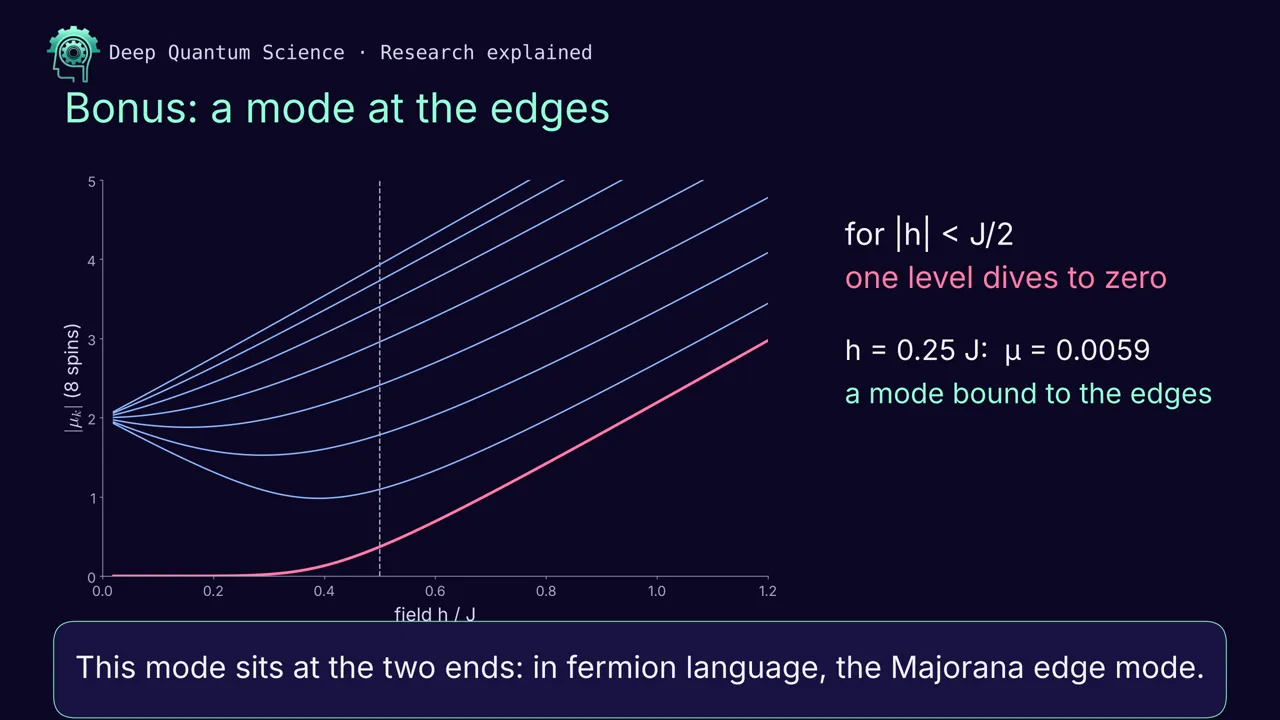
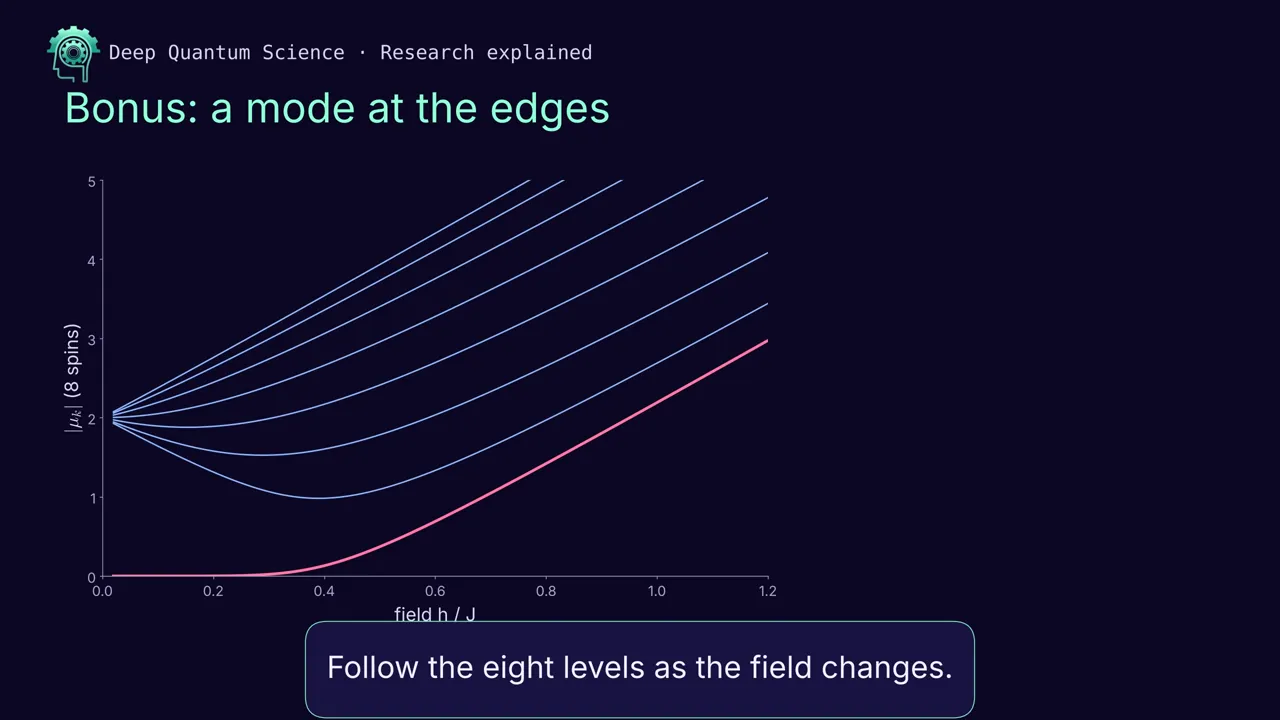
A Riccati equation becomes linear in a matrix twice as large, M = ((−B, −A), (A, B)). Its eigenvectors give P = YX−1, and its eigenvalues μk give the energy, E = (J/8) Σk μk (summed over the K negative eigenvalues). For 8 spins this gives −2.777054 J, identical to exact diagonalisation. In the bulk the eigenvalues follow the textbook Ising dispersion μk2 = c2 + 4 − 4c cos k, with momenta fixed by the chain ends through sin((K+1)k) = λ sin(Kk).
Bonus: a mode at the edges
For |h| < J/2 one solution of the quantisation condition becomes complex, and one level drops to almost zero: μ = 0.0059 for 8 spins at h = 0.25 J. This mode is bound to the two ends of the chain. In fermion language it is the Majorana edge mode, a close relative of the edge spins of the Haldane chain.