One machine, all the energies: perturbation theory with matrices
A compact matrix recursion gives every eigenvalue and eigenstate at once, to any order. We run it, and show exactly when and why it breaks.
Dieser Artikel ist auf Englisch verfügbar.

The previous article built the energy by hand, order by order. The appendix of our paper turns the whole procedure into a machine that only uses matrix operations, and that gives every state at once.
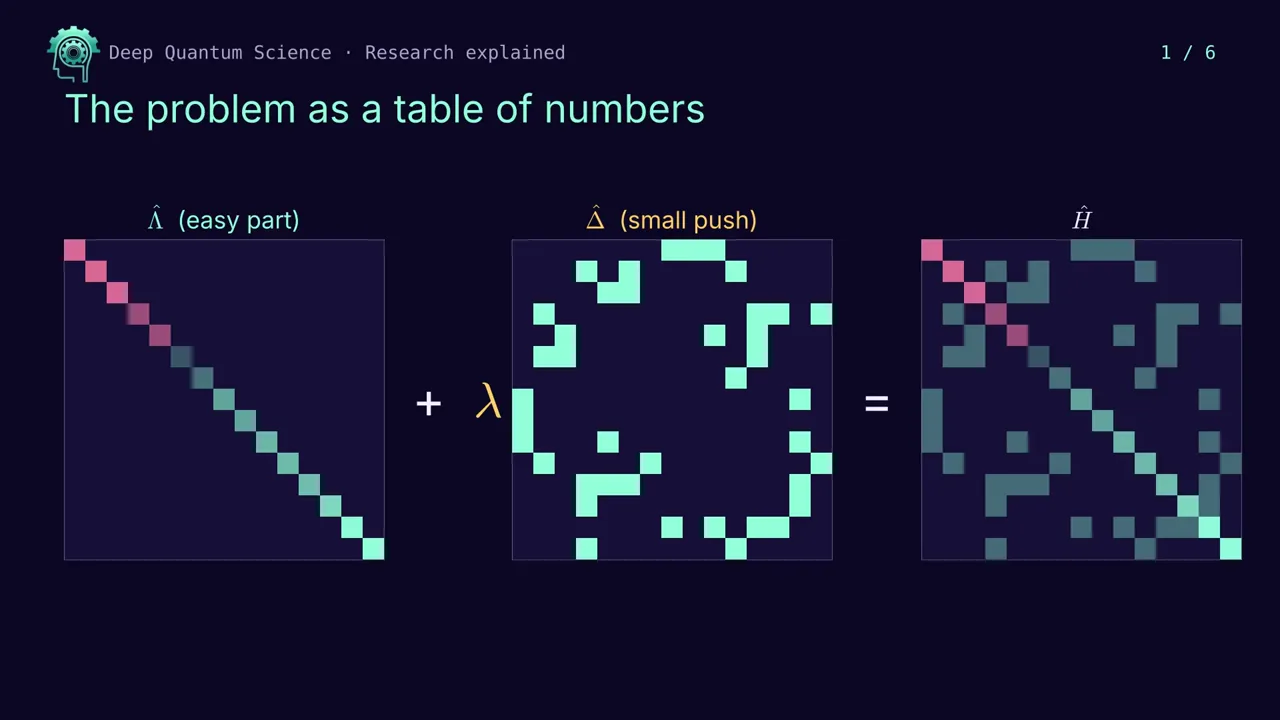
The problem as a table of numbers
We write the Hamiltonian as H = Λ + λΔ: a diagonal, easy part Λ with entries εn, and a small off-diagonal push Δ of size λ.
Store every correction in a matrix
Energies and states are expanded as series in λ. Each correction to state n is a mix of the simple states, |ψn(k)⟩ = Σj Aj,n(k) |j⟩. Stacking these numbers gives one matrix A(k) per order, with one column per state. Two rules fix everything: A(0) is the identity, and corrections never point back along the original state, so the diagonal of A(k) is empty. The energy corrections are then read off a diagonal:
The machine
With the gap table θj,n = 1/(εj − εn) (zero on the diagonal), the next correction follows from the previous ones:
Here ∘ is the cell-by-cell (Hadamard) product and D keeps only the diagonal. In words: take the previous correction, mix it with Δ using ordinary matrix products, multiply cell by cell by the gap table, and repeat.

Turning the crank
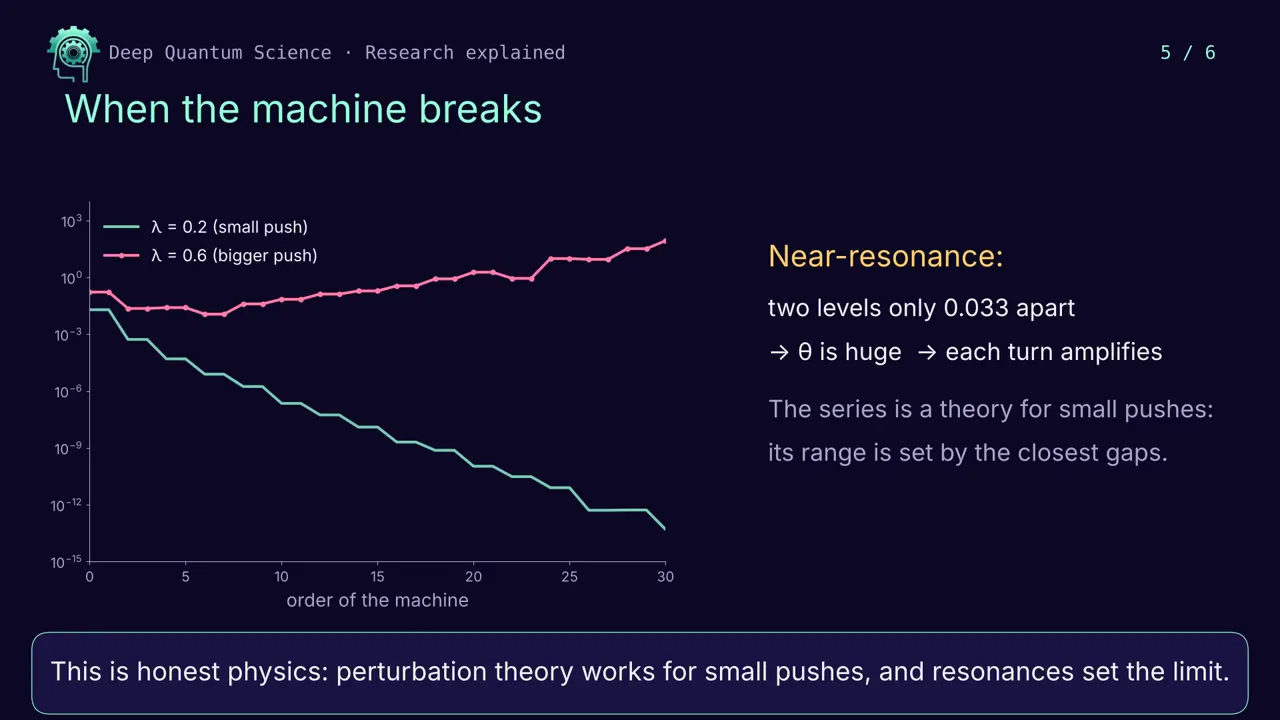
On our six-site chain with λ = 0.2, the error drops by orders of magnitude with each even order and reaches about 10−13 after 30 orders; odd orders change nothing, as expected from the bipartite structure.
When the machine breaks
Push harder, λ = 0.6, and the error first decreases, then explodes. The reason is a near-resonance: two levels only 0.033 apart give a huge entry in θ, which is amplified at every order. Perturbation theory is a theory for small pushes, and the closest gaps set its range.